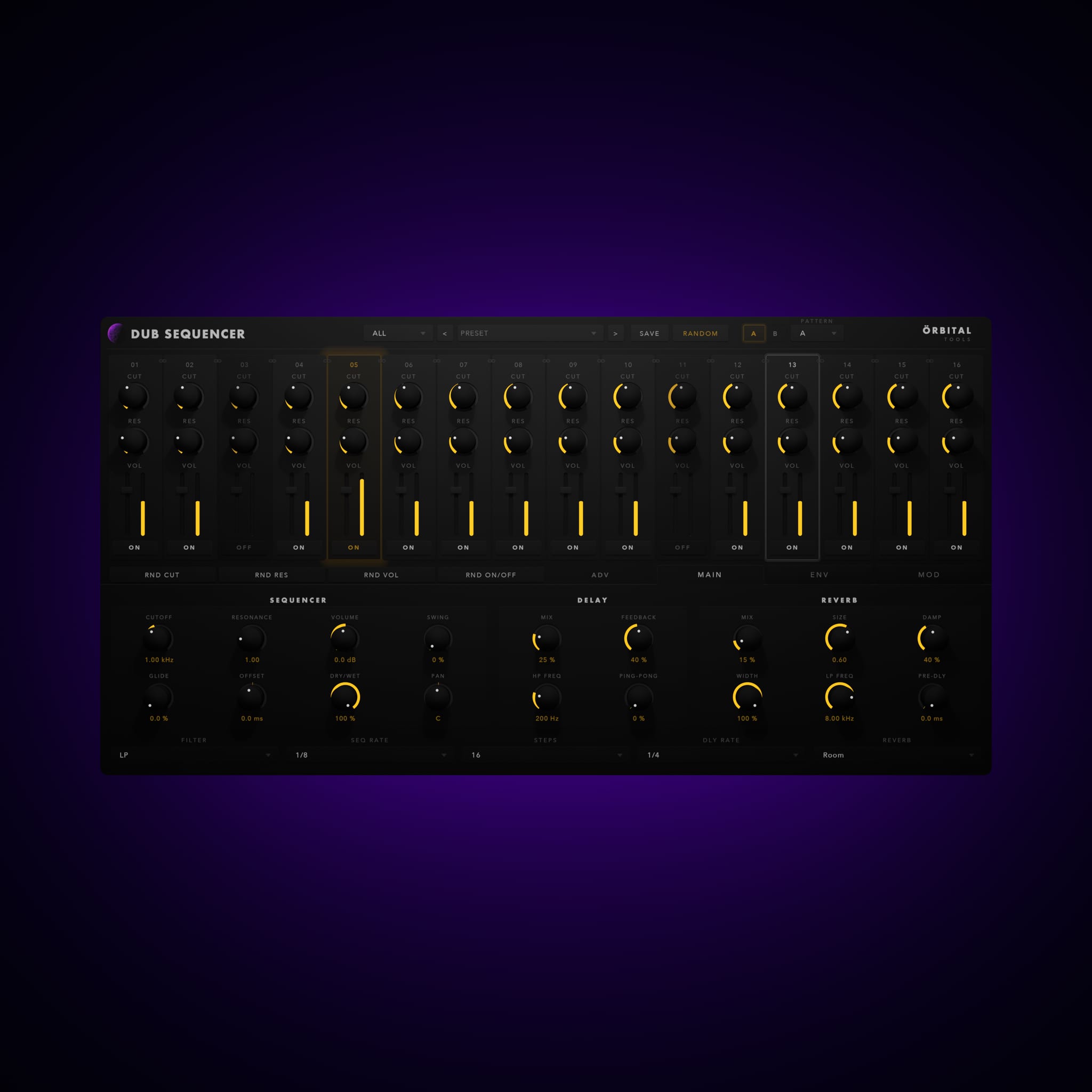
32 Steps, Two Banks
Sixteen steps per bank and a pattern that decides how the two play: A, AB, AAB, AABB, AAAB, ABBB. A figure can run over four bars instead of repeating every one. Chain steps together and they become one longer step, with the envelope stretched across the whole block.
An Envelope Per Step
Rise, fall and sustain on both volume and filter, set in percentages of the step so they hold their shape at any tempo. Drag the nodes in the graph to bend a segment into a curve. Filter depth is in octaves, so a sweep stays musical instead of arbitrary.
Modulate Anything
Three LFOs, free in hertz or locked to your DAW from an eighth note to sixteen bars, with six shapes including sample and hold. Right-click any knob or fader — including the ones inside the step grid — and hand it to an LFO. A ring around the control shows the range and where the LFO is right now.
Envelope Follower
A fourth modulation source driven by what comes in rather than a clock. Two-sided: it can open its targets as the input gets louder, or duck them. Percussive material drives it hardest, which makes it the fastest way to get a pattern moving with the track instead of against it.
Dub Delay
Ping-pong delay locked to your DAW from 1/32 to a bar, with a high pass inside the feedback loop so repeats come back thinner and recede instead of piling up. Switch the send on for one step and leave the rest dry — the dub move, without automation lanes.
Five Reverbs
Room, Plate, Hall, Spring and Chamber. The type shifts decay, damping, width and bandwidth around whatever the knobs are set to. Spring runs the send through a chain of allpass filters for the smear you would expect from a real one.